
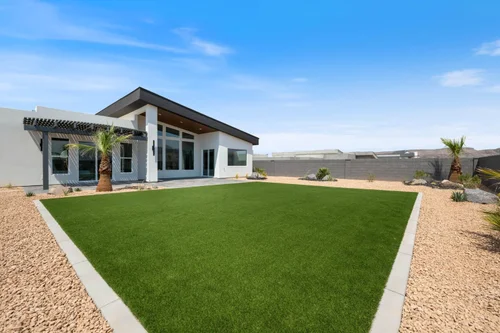
There's a moment in almost every home search where the decision quietly shifts. You stop asking “which house should I buy?” and start asking “should I be buying at all, or building?”
It's a bigger question than it looks. Custom and production homes aren't just two price points on the same spectrum — they're genuinely different products, with different tradeoffs in time, control, stress, and long-term satisfaction.
This guide lays out the honest comparison, including the parts that don't favor custom building. Because the right answer depends entirely on what you value, and plenty of people are better served by a production home.
▶ Not sure which path fits? Talk to Urban Desert Homes — we'll give you a straight assessment, even if the answer is that building isn't right for you. Call (435) 272-2526.
The Three Options, Clearly Defined
The terminology gets muddled in marketing, so let's be precise.
Production (Tract) Homes
A large builder develops a subdivision and offers a fixed menu of floor plans — usually four to eight — repeated across the community. You pick a plan, pick a lot, and choose from a curated list of finish packages at a design center.
Efficiency is the entire model. The builder buys materials in volume, runs the same crews through the same plans repeatedly, and passes some of that savings on.
Semi-Custom Homes
A middle path. You start from an existing plan but can modify it — move a wall, extend a room, change the elevation, swap a bedroom for an office. Finish selections are broader than a production design center but not unlimited.
For a lot of buyers, this is the sweet spot: meaningful personalization without a full ground-up design process.
Fully Custom Homes
The home is designed for you, your lot, and how you actually live. Every decision is yours — layout, orientation, ceiling heights, window placement, materials, systems.
Where Production Homes Genuinely Win
Let's be fair to the option most custom builders skip past.
Speed
If you need to be in a home within six months, production is often the only realistic route. Custom design and permitting alone can consume that window.
Price Certainty
You're quoted a number for a known plan the builder has constructed dozens of times. Fewer unknowns, fewer surprises.
Simplicity
Some people find hundreds of decisions energizing. Others find it exhausting. If choosing between four cabinet options sounds better than choosing between forty, that's a legitimate preference — not a compromise.
Financing Ease
A traditional mortgage on a completed home is simpler than a construction loan that converts to permanent financing.
Where Custom Homes Pull Ahead
The Home Fits Your Actual Life
This sounds soft until you've lived in a home that doesn't fit. If you work from home, cook seriously, host extended family, have aging parents moving in, or need a shop for a hobby — a stock plan will compromise on at least one of those.
Custom design starts with how you spend your days, not with what sold well in the last subdivision.
The Lot Drives the Design
This matters more in Southern Utah than in most markets. Our lots have views, grade changes, and brutal sun exposure, and a plan designed generically can waste all three.
A custom home can put the great room where the view is, shield the west-facing glass from afternoon heat, and step the foundation with the natural grade instead of fighting it. A production plan drops the same footprint on every lot and hopes for the best.
Build Quality You Can Actually Verify
On a custom build you can specify what goes inside the walls — insulation levels, window performance, HVAC sizing, framing details. On a production home, those specs are set by the builder's standard package and you take what's offered.
In a climate with triple-digit summers, that difference shows up on your utility bill every month for decades.
No Renovation Regret
Buyers who purchase a production home and immediately renovate the kitchen, refinish the floors, and reconfigure the primary suite frequently spend enough to have closed much of the gap to a custom build — while living through a remodel.
▶ Curious what a home designed around your lot could look like? Browse our floor plans and portfolio, then reach out for a free consultation.
The Real Cost Comparison (Including What People Forget)
Production homes are cheaper per square foot. That's not in dispute. But the honest comparison includes a few things buyers routinely leave out.
Upgrade creep — the base price of a production home rarely reflects what buyers actually spend once they're standing in the design center
Lot premiums — the good lots in a subdivision carry surcharges, sometimes substantial ones
Post-purchase changes — what you'll spend fixing what didn't fit
Landscaping — often excluded in both models, but easy to forget
Efficiency over time — a better-built envelope costs more upfront and less every month afterward
Run those numbers honestly and the gap narrows for many buyers. It doesn't close — custom is still more expensive — but the comparison is closer than the sticker prices suggest.
Which One Should You Choose?
Choose a Production Home If…
You need to move within six months
Your budget is firm with little flexibility
You like a plan you've already walked through
Decision fatigue is a real concern for you
You're comfortable in a subdivision with an HOA and consistent architecture
Choose Semi-Custom If…
You mostly like an existing plan but need a few real changes
You want some personalization without a full design process
You have moderate timeline flexibility
Choose Fully Custom If…
You own — or want — a specific lot with views or unusual characteristics
Your needs don't fit a standard plan (multigenerational living, home business, workshop, accessibility)
You plan to stay long-term and want the home to be right
You care about build quality specifics and want a say in them
You have 12–20 months and the appetite to be involved
A Question Worth Asking Yourself
How long do you plan to live here?
If the answer is five years, a production home is often the pragmatic call. If the answer is “this is the last house we buy,” the math and the emotional case both shift toward custom — because you'll be living with every compromise, or every good decision, for a very long time.
Let's Figure Out Which Fits You
We build custom homes, so you'd expect us to push that direction. We don't. Plenty of people who call us are better served by a production home, and we'll tell them so.
What we can offer is a clear-eyed conversation about your lot, your budget, your timeline, and what's actually realistic — before you spend anything.
▶ Contact Urban Desert Homes for an honest assessment. Call (435) 272-2526 or email UrbanDesertHomes@gmail.com.
Frequently Asked Questions
Is a custom home more expensive than a production home?
Yes, typically 20–40% more per square foot. However, the gap narrows once you account for production home upgrades, lot premiums, and post-purchase renovations. Custom homes also tend to be built with better envelopes and systems, which reduces long-term operating costs.
What is a semi-custom home?
A semi-custom home starts from an existing floor plan that you can modify — moving walls, resizing rooms, changing elevations — with a broader finish selection than a production design center offers. It's a middle option between a tract home and a fully custom build.
How long does a custom home take compared to a production home?
Production homes typically take 4–8 months to build. Custom homes take 12–20 months total, including 3–6 months for design and permitting plus 9–14 months of construction. Semi-custom builds usually fall in between.
Do custom homes have better resale value?
Custom homes in desirable locations often hold value well, particularly when the design is broadly appealing rather than highly personalized. Very unusual layouts can narrow the buyer pool. Location, build quality, and timeless design matter more than customization itself.
Can I build a custom home on a lot in an existing subdivision?
Often yes, though HOA architectural guidelines and design review requirements may apply. Some subdivisions restrict which builders can work there. Confirm the covenants and any builder restrictions before purchasing the lot.
